

From the Rhine Valley to Aachen

The route takes in North Rhine-Westphalia, passing through Cologne, Bonn and Aachen. The origins of these towns date back to antiquity, and they have managed to preserve their heritage. Romanesque art flourishes here, and the Gothic cathedrals are imposing.
For the first fifty kilometres, the route is guided by the Rhine, before heading west towards the wooded hills and protected wilderness of the North Eifel.
In Germany, EuroVélo 3 is signposted D-Route 7.
< Cologne (Köln)
Aix-la-Chapelle >
Itinerary Eurovelo3, recommended by CTE
→ click on map to go to a stage
De Namur à Tours par l'Eurovélo3
It is completely free.
Join us : https://eurovelo3.fr/adhesions/
The 4 stages of the section “From the Rhine Valley to Aachen”
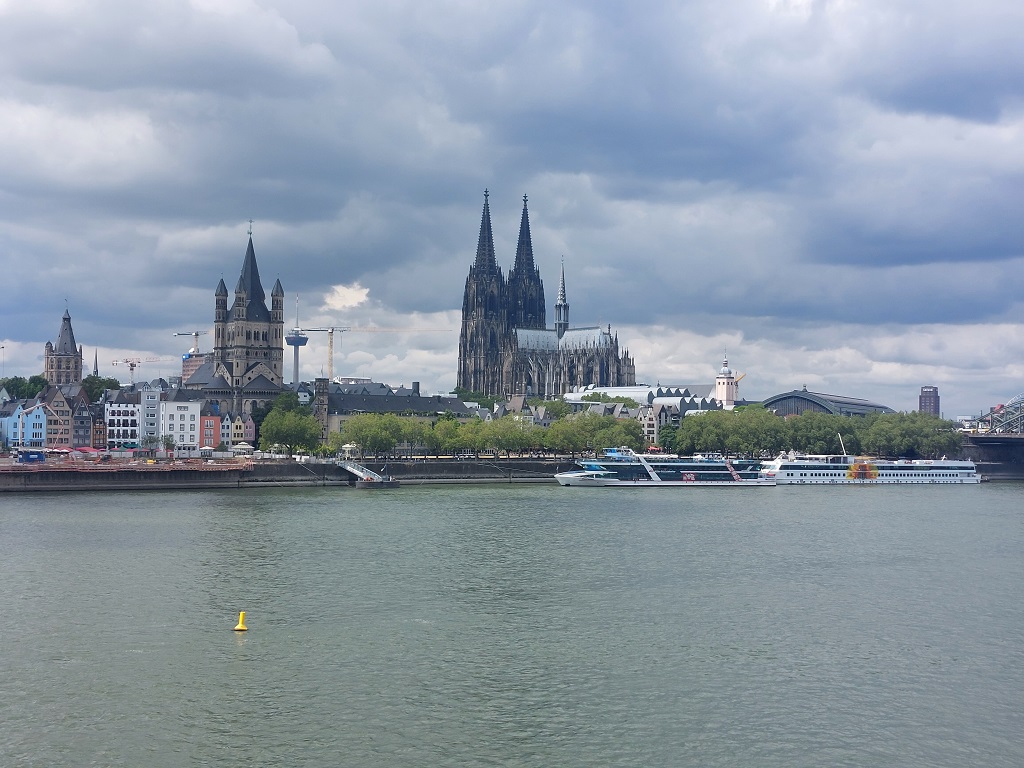
Cologne is a very touristy, dynamic and cosmopolitan city. As well as its impressive Gothic cathedral, numerous Romanesque churches and colourful houses with pointed gables, the city boasts buildings with bold contemporary architecture, including the three crane-shaped towers in the Kraushaüser district.
From Cologne to Bonn, the route follows the meandering course of the Rhine, where the ecologically valuable flood meadows are increasingly threatened by urban sprawl.

Bonn is the former capital of West Germany (1948-1991). The Bethoveen House, the botanical garden at Poppelsdorf Castle and the architecturally stunning Bundeskunsthalle museum are good reasons to visit the city.
You leave the banks of the Rhine at Mehlem and climb towards the Eifel massif. A little before Meckenheim, the town of a thousand apple trees, you pass Gudenau Castle surrounded by its wide moat, and at Rheinbach, you enjoy its pretty little historic centre with its traditional half-timbered houses.

This stage, alternating greenways or similar and village crossings, is a real pleasure and also invites cultural breaks : the spinning mill museum in Euskirchen and the open-air museum in Kommern – a real journey into the past, from the 15th. S to the present day.
After Hergarten, gateway to the l’Eife National Park, fields and meadows give way to deciduous forests and wilder nature. A fine descent leads to Heimbach, which can be spotted in the distance by its medieval castle. The route winds back from the River Rur, sometimes on the right bank, sometimes on the left.

At Nideggen, a diversion to the castle offers a breathtaking view of the Rur valley. Then a verdant sequence between forests and open meadows.
Körnelimünster, a former abbey town and place of pilgrimage, has preserved its medieval historic centre with half-timbered houses and quarry stone.
You can reach Aix-la-Chapelle via a route on shared roads or via the Vennbahn – click on the “variant lanes” pictogram.